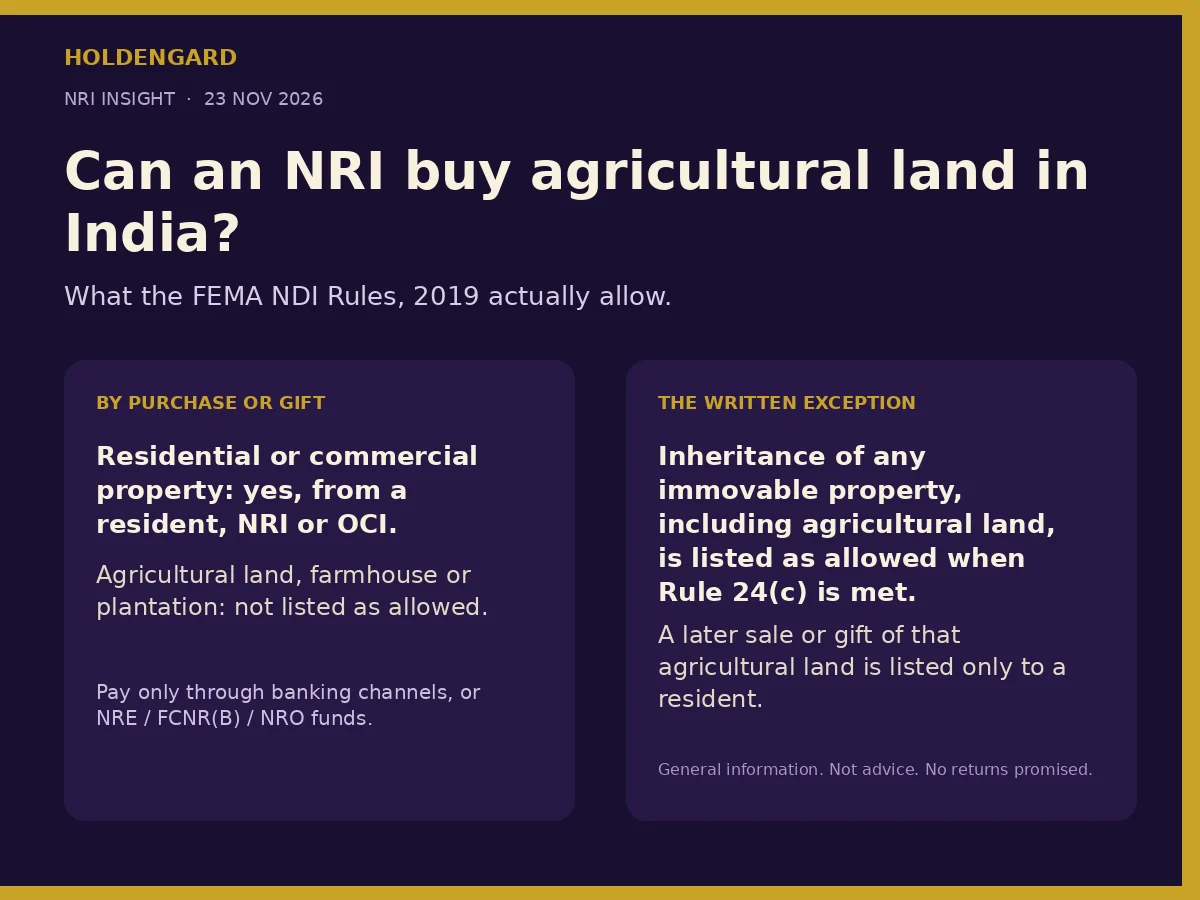


Can an NRI or OCI inherit immovable property in India — including agricultural land — and is inheritance itself taxed? Yes: under Section 6(5) of the Foreign Exchange Management Act (FEMA) and Reserve Bank of India (RBI) rules, an NRI or OCI cardholder may lawfully inherit residential, commercial or agricultural property in India from a resident Indian (or from a non-resident who acquired it in compliance with FEMA), with zero inheritance or estate tax at the point of succession; Indian capital gains tax applies only when you eventually sell, carrying forward the previous owner's original cost and holding period.
Please read this first. Holdengard is not a broker or adviser. It is not RERA-registered and holds no real-estate licence at present. It lists no properties and takes no fee on any transaction. This page is general information, not legal, tax or investment advice. Succession laws, probate rules and revenue procedures vary by personal law and state, so verify every point with a licensed local professional: a lawyer, a chartered accountant and your authorised dealer bank.
Try it with your own numbers
Compare keeping vs selling in the free Rental Yield and ROI Calculator
Test net rental yield after society maintenance, property tax, repairs and vacancy before making a family decision.
Compare keeping vs selling in the free Rental Yield and ROI CalculatorWhat FEMA Section 6(5) and RBI rules allow an NRI or OCI to inherit — and whom you may sell to
Under the Foreign Exchange Management (Non-debt Instruments) Rules, 2019 and RBI FAQ Id=1855, non-residents cannot buy agricultural land, yet enjoy broad protection when inheriting family property without needing prior RBI permission merely to hold title. However, whom you may later sell to depends on the asset class:
| Inherited property type | Can an NRI/OCI hold it by inheritance? | Permitted buyer on a subsequent sale (without special RBI approval) |
|---|---|---|
| Residential flat, house or plot | Yes | Any person resident in India, or another eligible NRI or OCI cardholder (per FEMA NDI Rules) |
| Commercial shop or office | Yes | Any person resident in India, or another eligible NRI or OCI cardholder (per FEMA NDI Rules) |
| Agricultural land, plantation or farmhouse | Yes (inheritance permitted even though purchase is barred) | Strictly a person resident in India who is an Indian citizen (cannot be sold to another NRI/OCI without prior RBI approval) |
Citizens of specific restricted countries named in FEMA Non-debt Instruments Rules remain subject to prior RBI permission unless covered by applicable OCI exemptions — always confirm citizenship and residency status with your authorised dealer bank.
Four succession documents families confuse: Will, Probate, Legal Heir Certificate and Release Deed
Any Power of Attorney signed by a parent during their lifetime terminates automatically upon death (see NRI Power of Attorney for property in India: rules and checks). Establish clean succession using the right instrument for your situation:
| Succession scenario | Primary legal document | Issuing or registering authority | Classic mistake to avoid |
|---|---|---|---|
| Deceased left a valid Will | Will + Probate (where required locally or by society/bank) | Competent High Court / District Court under the Indian Succession Act, 1925 | Assuming notarisation replaces court probate where local law, societies or buyer banks require it (historically presidency cities Mumbai, Chennai and Kolkata — verify current state rules with a lawyer) |
| Intestate death (no Will) — routine administrative transmission | Legal Heir / Surviving Member Certificate | Revenue Tehsildar / Taluka / SDM office after death certificate and inquiry | Treating a revenue heir certificate alone as conclusive title when a bank requires a court grant |
| Intestate death — court title administration | Letters of Administration (or civil-court Succession Certificate for debts/securities) | Competent Civil / District / High Court under the Indian Succession Act, 1925 | Confusing movable-asset Succession Certificates with Letters of Administration for real estate |
| Co-heirs inheriting jointly, where one sibling waives their share | Registered Release / Relinquishment Deed (or Registered Family Partition Deed) | Stamped per state schedule and registered at the Sub-Registrar under Registration Act Sec 17 | Using an unregistered ₹100 stamp-paper "NOC Affidavit" — an unregistered NOC never extinguishes a co-owner's legal share |
Why municipal or revenue Mutation (Dakhil-Kharij) is NOT legal title
Across Mumbai, Delhi NCR and state tehsils, heirs often stop once the property-tax bill, society share certificate, 7/12 extract or Dakhil-Kharij entry shows their name. Supreme Court rulings confirm that mutation in revenue or municipal records is purely for fiscal tax collection and neither creates nor extinguishes ownership title — legal ownership rests on the parent's registered deed plus valid succession and registered Release Deeds.
Never skip mutation or society transmission, however: buyer home-loan banks require matching tax bills, society NOCs and clean Encumbrance Certificates (see NRI plot paperwork: mutation, EC, PoA and site checks) before disbursing funds.
Capital gains tax under the Income-tax Act, 2025 when selling inherited property
Receiving property under a Will or inheritance carries zero income tax, while selling it triggers capital gains tax under three statutory rules in the Income-tax Act, 2025 (effective 1 April 2026):
- Combined holding period: Your holding period includes the deceased previous owner's holding period; over 24 months combined qualifies as Long-Term.
- Carried-forward cost: Your cost is what the previous owner paid (plus documented capital improvements), or for pre-1 April 2001 acquisitions, a registered valuer's 1 April 2001 Fair Market Value (capped at 1 April 2001 stamp-duty value where applicable).
- 12.5% base LTCG without indexation for non-residents: Non-resident long-term capital gains on Indian real estate are taxed at 12.5% without indexation, plus surcharge (capped at 15% on LTCG) and 4% cess (~14.95% max effective; the pre-23 July 2024 indexation comparison option applies only to resident individuals/HUFs — ask your CA about rollover exemptions into an Indian house or capital-gains bonds).
Illustrative worked example: planning buyer TDS before signing
In an illustrative example, suppose your father bought a flat in 2009 for ₹40,00,000, you inherited it in 2025, and in November 2026 you sell it as an NRI for ₹1,60,00,000 (17-year combined holding; net LTCG ₹1,20,00,000). Under Section 393(2) (legacy Section 195), a buyer without a certificate withholds ~13% to 14.95% on the full ₹1,60,00,000 price (~₹20.8 lakh to ₹23.92 lakh). Obtaining an Assessing Officer certificate under Section 395 / Form No. 128 (legacy Section 197 / Form 13) beforehand aligns withholding strictly to your ₹1,20,00,000 gain — see NRI selling property in India: buyer TDS and exit rules.
Repatriating inherited sale proceeds: RBI's USD 1 million per financial year NRO rule
Under RBI's Master Direction — Remittance of Assets and FAQ Id=1855:
- Credit sale proceeds into your NRO account.
- Up to USD 1,000,000 per financial year (April–March): Authorised Dealer banks permit outward remittance up to USD 1 million per financial year across NRO capital/inherited balances without prior RBI approval.
- Submit four documents to your bank: (a) Inheritance proof (death certificate, Will/Probate or Legal Heir/Letters of Administration + registered Release Deeds), (b) registered Sale Deed and tax/TDS proof, (c) CA Form 15CB, and (d) online Form 15CA.
Model holding versus selling in Property Lab and explore our NRI hub.
Try it with your own numbers
Download the free Holdengard Seller Checklist
Organise prior title deeds, succession papers, society NOCs, buyer TAN clauses and NRO remittance records before listing.
Download the free Holdengard Seller ChecklistSources (read 15 November 2026)
Foreign Exchange Management Act, 1999 Section 6(5) and Foreign Exchange Management (Non-debt Instruments) Rules, 2019 (indiacode.nic.in). Reserve Bank of India (rbi.org.in): Master Direction — Remittance of Assets and FAQs on Purchase of Immovable Property in India (Id=1855) on the USD 1 million per financial year NRO ceiling. Income Tax Department (incometaxindia.gov.in and incometax.gov.in): Income-tax Act, 2025 (effective 1 April 2026) rules on exempt inheritance receipts, previous-owner cost and holding-period carry-forward, 1 April 2001 FMV cap, 12.5% non-resident LTCG rate, Section 393(2), Section 395 / Form No. 128, and Forms 15CA/15CB. Indian Succession Act, 1925 and Registration Act, 1908 Section 17.
Frequently asked questions
Does India charge inheritance tax when an NRI inherits parents' property?
No. India levies no estate duty or inheritance tax, and immovable property received under a Will or by inheritance is exempt from income tax at receipt. Tax applies only on rental income earned while holding it or capital gains upon selling it.
Can an NRI sell inherited agricultural land to another NRI?
No, not without prior RBI permission. While an NRI or OCI may hold agricultural land, plantation property or a farmhouse acquired by inheritance, selling it without special RBI approval is restricted strictly to a person resident in India who is an Indian citizen.
Does municipal property-tax mutation make me the sole owner if I have siblings?
No. Municipal or revenue mutation (Dakhil-Kharij) is purely for tax-collection records and never creates or extinguishes title shares. If a sibling waives their undivided share in your favour, execute a stamped and Registered Release (Relinquishment) Deed at the Sub-Registrar — an unregistered NOC affidavit will not clear title.
What if my parents bought the house before April 2001 or misplaced receipts?
Obtain a certified copy of the registered purchase deed from the Sub-Registrar. Where the previous owner bought before 1 April 2001, Indian tax law allows substituting a registered valuer's 1 April 2001 Fair Market Value (capped at the 1 April 2001 stamp-duty / circle-rate value where applicable) as your cost of acquisition.
Is Holdengard a broker, law firm or tax adviser, and can it handle my mutation or sale?
No. Holdengard is an information and community platform operated under B&M Global Solutions. It is not a broker, law firm or tax adviser, is not RERA-registered, holds no real-estate licence at present, lists no properties and takes no fee on deals. Always instruct a licensed local lawyer, chartered accountant and authorised dealer bank.