
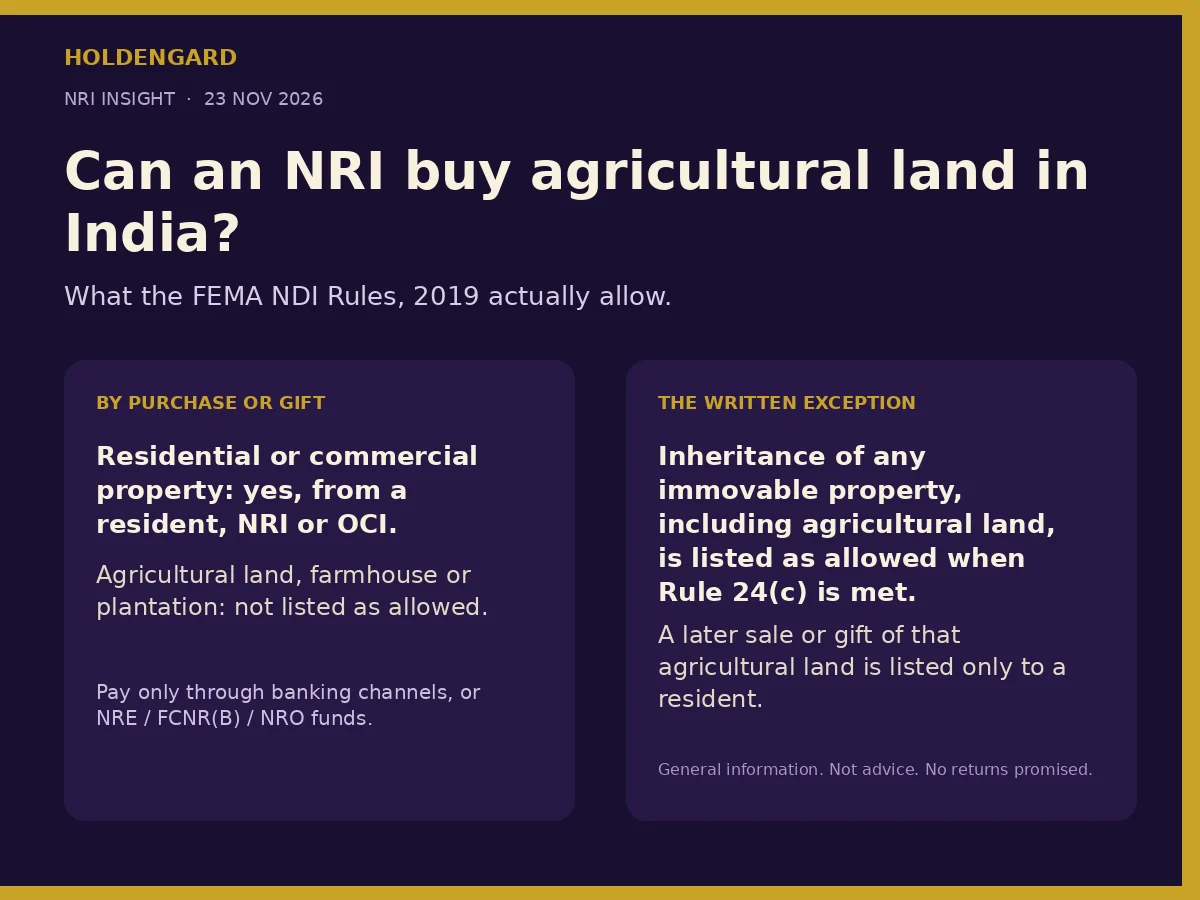
One of the questions we hear most from NRIs is whether they can buy a farm, a farmhouse or a tea or coffee plantation in India. The short answer from the current FEMA rules is: you may buy residential or commercial immovable property, but you may not purchase agricultural land, a farmhouse or plantation property. Inheritance is treated differently. The details matter, because a booking in the wrong category is hard to unwind.
Please read this first. Holdengard is not a broker or adviser. It is not RERA-registered and holds no real-estate licence at present. It is a property-information site for NRIs and local buyers and sellers of every budget, and it is intended to show properties from partner brokers. It promises no return. This page is general information, not legal, tax or investment advice. Confirm the current Foreign Exchange Management (Non-Debt Instruments) Rules, 2019 with a licensed local lawyer and, for money moving from abroad, your chartered accountant and authorised dealer bank. State land-revenue laws can add restrictions on top of FEMA.
What the current FEMA rules actually say
The Reserve Bank of India's FAQ on purchase of immovable property, updated on 6 April 2023 and read by us on 23 November 2026, says the principal rules are the Foreign Exchange Management (Non-Debt Instruments) Rules, 2019 (the NDI Rules), as amended, together with Part II of Master Direction No. 12 on acquisition and transfer of immovable property under FEMA, 1999.
In that FAQ, Rule 24 is summarised in a table for an NRI (a person resident outside India who is a citizen of India) and an OCI (a person resident outside India who is registered as an Overseas Citizen of India cardholder under section 7A of the Citizenship Act, 1955).
| What you want to do | What the RBI FAQ, citing NDI Rule 24, lists |
|---|---|
| Buy immovable property | Allowed, other than agricultural land, a farmhouse or plantation property, from a resident, an NRI or an OCI |
| Receive it as a gift | Allowed, other than agricultural land, a farmhouse or plantation property, and only from a relative (as defined in section 2(77) of the Companies Act, 2013) who is a resident, an NRI or an OCI |
| Inherit immovable property | Allowed for any immovable property, including agricultural land, if it comes from a person who acquired it under the laws then in force, or from a resident |
| Sell agricultural land (or gift it) | Only to a person resident in India |
| Sell or gift other immovable property (residential or commercial) | To a resident, an NRI or an OCI |
Two points follow directly from that table.
First, a purchase or a gift is not a way around the agricultural-land bar. The exclusion for agricultural land, farmhouses and plantation property sits on both the purchase row and the gift row.
Second, inheritance is the main exception written into the same rule. If you inherit a farm, FEMA as summarised by RBI still lets you hold it. When you later transfer it, you may sell or gift that agricultural land only to a resident. Our note on inheriting property in India as an NRI covers mutation, tax and repatriation in more detail. Take advice on the title, the land-revenue classification and any state ceiling or tenancy law before you assume the inheritance is clean.
How you may pay, if the purchase is allowed
For property you are allowed to acquire, the same FAQ says payment must be received in India through banking channels and is subject to Indian taxes and other duties or levies. Payment may also come from funds held in the NRI's or OCI's NRE, FCNR(B) or NRO accounts. Payments must not be made by travellers' cheques or foreign currency notes.
If you are still opening or using those accounts, see our NRE and NRO account guide. Your authorised dealer bank should confirm the route that applies to your facts.
A spouse who is not an NRI or OCI
The FAQ, citing Rule 25 of the NDI Rules, says a person resident outside India who is not an NRI or an OCI, but who is the spouse of an NRI or OCI, may acquire one immovable property (other than agricultural land, a farmhouse or plantation property), jointly with that NRI or OCI spouse, subject to the conditions in Rule 25. It is not a route to a farm, and it is not a route to a property in the non-NRI spouse's sole name.
Citizens of certain countries, and foreign nationals
The same FAQ is stricter for some passports. It says citizens of Pakistan, Bangladesh, Sri Lanka, Afghanistan, China, Iran, Nepal, Bhutan, Macau, Hong Kong or the Democratic People's Republic of Korea cannot, without prior RBI permission, acquire or transfer immovable property in India, other than a lease not exceeding five years, regardless of their residential status. That prohibition is stated not to apply to an OCI.
Foreign nationals of non-Indian origin who are resident outside India are described as able to take a lease not exceeding five years, and to acquire property by inheritance from a resident. Other acquisitions or transfers by foreign nationals need prior RBI permission, according to that FAQ. This is a separate issue from the NRI/OCI agricultural-land rule, and it is easy to miss if one spouse holds one of the listed passports.
What happens to sale proceeds
If you sell property you were allowed to hold, repatriation is not automatic.
The FAQ states that a person who acquired the property under section 6(5) of FEMA (property acquired when the person was resident in India, or inherited from a person who was resident in India), or that person's successor, cannot repatriate the sale proceeds without RBI approval.
Separately, it says NRIs and PIOs may remit the sale proceeds of immovable property other than agricultural land, a farmhouse or plantation property, if all of the following hold:
- the property was acquired in accordance with the foreign exchange law in force at the time, or the NDI Rules, 2019;
- the amount for acquisition was paid in foreign exchange received through banking channels, or out of an FCNR or NRE account; and
- in the case of residential property, repatriation of sale proceeds is restricted to not more than two such properties.
There is also a separate USD 1 million per financial year facility, along with other assets, under the Foreign Exchange Management (Remittance of Assets) Regulations, 2016, for certain inherited or retirement situations listed in the FAQ. That is not a general "sell any farm and take USD 1 million out" rule. Ask your authorised dealer and a chartered accountant which facility, if any, applies to your case.
A few practical checks before you pay a token
- Ask how the land is classified on the revenue record, not only in the brochure. A plot marketed as a "farmhouse community" or "plantation township" may still be agricultural land for FEMA and for the state land-revenue law.
- Do not treat a relative's name as a shortcut. Putting agricultural land in a resident relative's name, with a side agreement that it is "really yours", can create title, tax and enforcement problems. Get a lawyer's advice before you do anything of that kind.
- If you already inherited agricultural land, plan the eventual sale or gift only to a resident, and keep the inheritance documents, mutation and tax trail in order.
- For a residential or commercial purchase that is allowed, work through the usual title, RERA (if it is a registered project), agreement and payment-route checks. Start with our NRI buying roadmap and, if you will rent the property out, test your own numbers on the free rental yield and ROI calculator. A yield figure is not a return promise.
Try it with your own numbers
Try the free rental yield calculator
Use your own price, rent and cost assumptions. It is a worksheet, not a forecast or a promise of return.
Try the free rental yield calculatorSources checked
Reserve Bank of India, "Purchase of Immovable Property" Frequently Asked Questions, updated 6 April 2023 (Part II, Non-Resident Individuals), citing the Foreign Exchange Management (Non-Debt Instruments) Rules, 2019, including Rules 24, 25 and 28, and Part II of Master Direction No. 12 on Acquisition and Transfer of Immovable Property under FEMA, 1999; also the Foreign Exchange Management (Remittance of Assets) Regulations, 2016 as referred to in that FAQ. All read on 23 November 2026. Confirm the current consolidated NDI Rules and any later amendment with your lawyer and authorised dealer, because an FAQ is an explanation, not the legal text itself.
Frequently asked questions
Can an NRI or OCI buy agricultural land, a farmhouse or a plantation in India?
Not by purchase, according to the RBI FAQ on the NDI Rules, 2019, Rule 24, as read on 23 November 2026. The same exclusion applies to gifts of those categories. Inheritance of any immovable property, including agricultural land, is listed as allowed when the conditions in Rule 24(c) are met.
If I inherit a farm, can I sell it to another NRI?
The FAQ says agricultural land may be sold or gifted only to a person resident in India. A sale to another NRI is not in that row. Confirm the current rule and any state land-law limits with a local lawyer before you agree a price.
Can my non-NRI spouse and I buy a farm jointly?
The Rule 25 summary in the same FAQ allows one immovable property, other than agricultural land, a farmhouse or plantation property, to be acquired jointly by an NRI or OCI and a non-NRI/OCI spouse, subject to Rule 25 conditions. It does not open a route to agricultural land.
How should I pay for a residential flat I am allowed to buy?
The FAQ says payment must come through banking channels in India, or from funds in an NRE, FCNR(B) or NRO account, and that travellers' cheques and foreign currency notes are not allowed. Taxes and duties in India still apply. Ask your authorised dealer to confirm the route for your accounts.
Can I repatriate the sale proceeds of a farm I inherited?
The general remittance of sale proceeds described in the FAQ is for immovable property other than agricultural land, a farmhouse or plantation property, and it has extra conditions. Inherited property acquired under section 6(5) of FEMA is also described as needing RBI approval before sale proceeds can be repatriated. This is a point for your authorised dealer and chartered accountant, not a do-it-yourself step.
Does this page mean Holdengard can complete a farm or flat purchase for me?
No. Holdengard is not a broker, is not RERA-registered and promises no return. Use the official rules, a licensed local lawyer and your bank. If you are comparing a residential purchase, the rental yield calculator and the NRI buying roadmap are information tools only.