

NRI desk — plot paperwork, explained piece by piece
Plots behave differently from flats. There is no RERA promoter structure for most individual plot sales, the record trail runs through the revenue department as well as the sub-registrar, and the paperwork you sign abroad (a Power of Attorney) has its own timing rules back home. This guide walks through the four documents NRIs ask about most — the registered sale deed, the encumbrance certificate, mutation, and the Power of Attorney — plus the site checks that catch problems before money moves. Holdengard is an information brand: not a broker, not RERA-registered, and this is not legal advice.
What you are allowed to buy in the first place
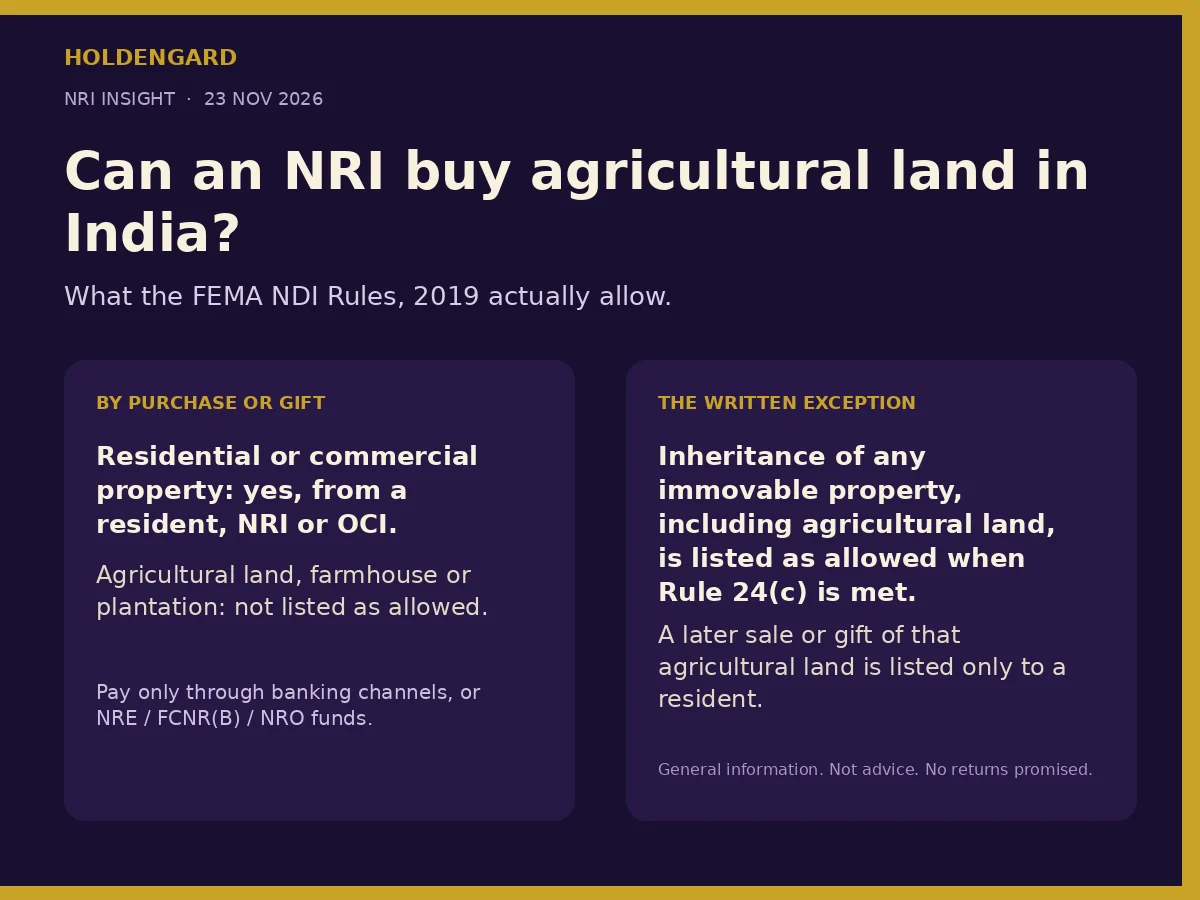
Before paperwork, confirm the purchase is permitted at all. Under India's foreign-exchange rules, the Reserve Bank of India's FAQ on immovable property states that an NRI or OCI can purchase any immovable property other than agricultural land, farm house or plantation property. Payments must arrive in India through banking channels — an inward remittance from abroad or a debit to your NRE, FCNR(B) or NRO account — and no purchase under the general permission needs any filing with the RBI. Our page on the NRE/NRO banking route covers how the money should travel.
1. The registered sale deed
The foundation of every plot purchase in India is registration. Under Section 17 of the Registration Act, 1908, a non-testamentary document transferring immovable property above the statutory value must be registered, and Section 23 sets the clock: the document must be presented to the proper registering officer within four months from the date of execution. For an NRI this has two practical consequences:
- Never rely on an unregistered agreement or a notarised receipt as proof of ownership of a plot. Ownership evidence begins with the registered instrument.
- If you buy remotely through a Power of Attorney holder, the deed must still be presented within that four-month window — so your PoA holder needs the complete document set before the signing date, not after.
Registration happens at the sub-registrar office whose jurisdiction covers the property. Verify the seller's identity at that office in person through your PoA holder and record it.
2. The encumbrance certificate (EC)
An encumbrance certificate lists the registered transactions against the property — sales, mortgages, releases — for the period you search. State registration departments run this as a public search. Telangana's Registration and Stamps Department, for example, states that citizens can search encumbrance details online 24×7, that the online search covers transactions after 1 January 1983 (earlier ones need the sub-registrar office), and that searches can be made by document number, house or apartment details, or survey number. Tamil Nadu's TNREGINET portal similarly offers EC search and view to registered users.
Three cautions the official pages themselves make:
- An EC reflects only what was registered in the period searched. A blank result (sometimes called a nil EC) is not proof that no transaction ever happened — only that none was registered in that window at that office.
- Property descriptions in legacy records are inconsistent, so a probabilistic search can return multiple entries; you must identify the correct one.
- For confirmation in doubtful cases, the department's own advice is to approach the sub-registrar office concerned.
Most lenders ask for roughly a 13–30 year EC. Ask your bank what period it needs rather than assuming.
3. Mutation — the record, not the title
After registration, the property's record in the local revenue or municipal records must move to your name; that update is commonly called mutation. Telangana's property-wise transactions page, for instance, routes urban property owners to a mutation fee and procedure module with their local body. Two things NRIs get wrong here:
- Mutation is not the title. The registered sale deed transfers ownership; mutation updates the assessing and revenue records so property tax and land records show you. Doing both is the point.
- Missing mutation shows up years later, when a resale, loan, subdivision or legal-heir matter forces the issue. If you manage the plot from abroad, complete mutation at purchase time, while your PoA holder is still active.
Exact portals and fees differ by state. Your lawyer or the local body office will tell you which portal applies to your plot — and the executor of your PoA should carry the registered deed to that appointment.
4. Power of Attorney from abroad
Many NRIs buy or manage plots through a relative holding a Power of Attorney. Indian law treats a PoA executed outside India with special care:
- Under Section 18 of the Indian Stamp Act, 1899, an instrument chargeable with duty that was executed outside India may be stamped within three months after it has been first received in India. Miss that window and the document is not duly stamped — which can make it inadmissible in evidence until the duty and penalty are paid.
- Getting the document authenticated at the start matters too: NRIs commonly execute the PoA before an officer at an Indian consulate abroad or get it apostilled under the Hague Convention (India's Ministry of External Affairs maintains the apostille process), so the document is accepted when it lands in India.
Practical drafting tips that come straight from how these documents fail in practice: name the specific property (survey number, village, district), grant powers that actually cover registration, mutation, tax payment and utilities, and set an expiry or revocation clause. A general-purpose PoA pulled from a template is what gets flagged by sub-registrar offices.
For a real example of how PoAs and signed papers can be misused against an absent owner, read the deed she says she never signed: an NRI plot case, on the Supreme Court's April 2026 order.
Site checks that no paper replaces
Documents prove recorded rights. Site checks test whether reality matches them:
| # | Check | What it catches |
|---|---|---|
| 1 | Plot dimensions vs the survey number and F-line/map on the ground | Boundary shrinkage, encroachment |
| 2 | Title chain (mother deed to present deed) read by a lawyer | Broken or defective ownership trail |
| 3 | Khata/patta/record-of-rights entry for the plot | Tax and revenue record mismatch |
| 4 | Land-use and zoning confirmation with the planning authority | Plots sold as residential but zoned otherwise |
| 5 | Developer/project status on the state RERA authority where a project is involved | Unregistered or disputed projects |
| 6 | Litigation search on the seller and the property | Attached or disputed land |
For new plotted developments, our five RERA checks before you pay a token and the RERA checklist tool take you through the project-level verification step by step.
Sources (read 3 November 2026)
- Reserve Bank of India — FAQ "Acquisition and Transfer of Immovable Property in India" and Notification FEMA No. 21/2000-RB (as amended), rbi.org.in: what NRIs may purchase, permitted payment channels, no RBI filing under general permission.
- The Registration Act, 1908 (India Code bare text): Sections 17 and 23.
- The Indian Stamp Act, 1899 (India Code bare text): Section 18 (stamping within three months of first receipt in India).
- Telangana Registration and Stamps Department, registration.telangana.gov.in: e-Encumbrance Statement page and Property-wise Transactions (mutation) pages; Tamil Nadu TNREGINET portal for EC search.
- Ministry of External Affairs, Apostille services, mea.gov.in.
Frequently asked questions
Does mutation prove I own the plot?
No. The registered sale deed is the instrument of transfer. Mutation updates revenue or municipal records so tax and land records carry your name. You need both done.
How far back should my EC search go?
Lenders commonly ask for a substantial period (often around 30 years); online systems differ by state — Telangana's online EC covers transactions after 1 January 1983. Ask your bank for its required period and confirm older records at the sub-registrar office if needed.
Can my parents sell a plot on my behalf without a PoA?
Only if they are co-owners. Otherwise they need a PoA that is validly executed abroad, received and stamped in India within three months, and covering the powers needed for the transaction.
Is a nil EC a guarantee that the plot is clean?
No. An EC lists registered transactions for the period searched. Undocumented possession claims, litigation and revenue-record mismatches are exactly why the site checks above exist.
Does Holdengard help me buy the plot?
No. Holdengard is an information and community brand for NRIs — not a broker, not RERA-registered, and not a legal adviser. Use licensed local professionals for transactions; we help you ask the right questions before you do.